
How to Teach Children Critical Thinking in the Age of AI
How to Teach Children Critical Thinking in the Age of AI Artificial intelligence is becoming part of everyday learning. Children can now ask AI questions, gener
Aalgorix World Academy
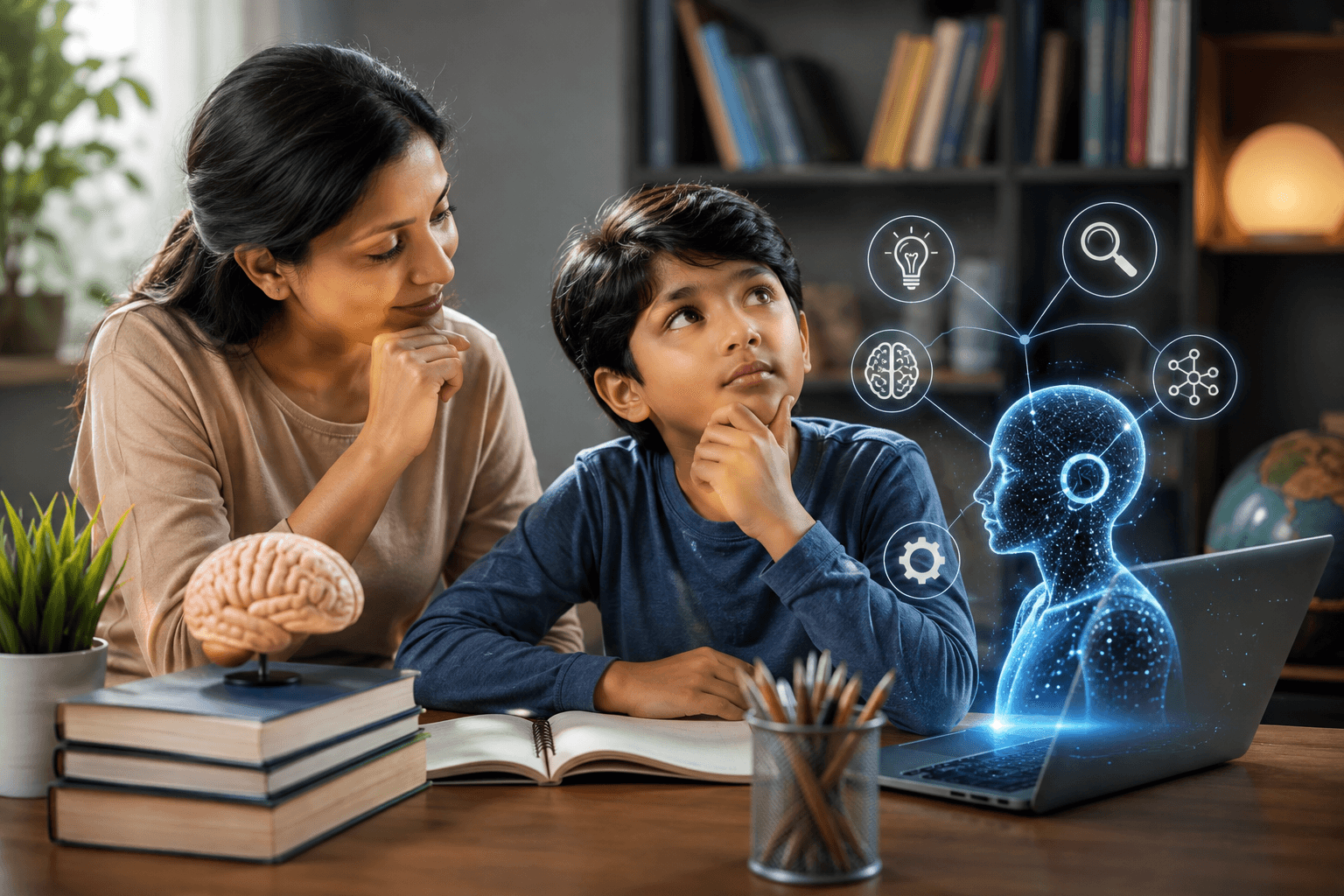
How to Teach Children Critical Thinking in the Age of AI
Artificial intelligence is becoming part of everyday learning. Children can now ask AI questions, generate ideas, solve problems, summarize information, and even receive personalized explanations within seconds.
But as AI becomes more powerful, one skill becomes even more important: critical thinking.
For homeschooling families, this creates an exciting opportunity. Instead of teaching children only what to learn, parents can also teach them how to think, question, evaluate, and make decisions independently.
What Is Critical Thinking?
Critical thinking means being able to look at information carefully before accepting it as true.
A child with strong critical-thinking skills learns to:
Ask meaningful questions
Identify facts and opinions
Compare different sources
Recognize mistakes and misinformation
Explain why they believe something
Consider different perspectives
Make decisions based on evidence
These skills are becoming increasingly important because AI-generated answers are not always correct.
1. Teach Children to Question AI
One of the simplest ways to develop critical thinking is to encourage children not to automatically accept an AI answer.
Instead of asking:
“What did AI say?”
encourage them to ask:
“How do we know this is correct?”
For example, if an AI tool gives an explanation about a historical event, ask your child to find another reliable source and compare the information.
This turns AI from an answer machine into a starting point for investigation.
2. Ask “Why?” and “How?” More Often
Homeschooling provides a unique advantage: learning doesn't have to stop when a question is answered.
If your child says:
“Plants need sunlight to grow.”
Ask:
“Why do they need sunlight?”
Then continue:
“What would happen if a plant received no sunlight?”
Questions like these encourage children to explore cause and effect instead of simply memorizing facts.
3. Teach Fact-Checking
AI can produce convincing answers even when some information is inaccurate.
Children should therefore learn basic fact-checking habits.
Teach them to:
Look for the original source.
Compare information from multiple reliable sources.
Check the date of the information.
Look for evidence supporting a claim.
Be cautious when something sounds too good to be true.
This is especially useful when children use AI for research projects.
4. Let Children Make Mistakes
Critical thinking doesn't develop when children are always given the correct answer immediately.
Sometimes, allow your child to make a prediction first.
For example:
“Which object do you think will sink?”
Let them explain their reasoning before conducting the experiment.
Then test the prediction.
The goal isn't simply to get the correct answer. The goal is to understand why the answer is correct or incorrect.
5. Turn AI Into a Debate Partner
AI can be useful for creating different viewpoints.
Ask it to present arguments on both sides of a question and then ask your child:
“Which argument do you find stronger, and why?”
For example:
Should children have homework every day?
Your child can examine different arguments, identify strengths and weaknesses, and form an independent opinion.
This teaches children that good thinking isn't always about finding one immediate answer.
6. Encourage Problem-Based Learning
Real-world problems are excellent opportunities for critical thinking.
Instead of simply teaching a mathematical formula, give children a practical challenge.
For example:
“We have ₹1,000 to plan a family picnic. What can we buy while staying within the budget?”
The child must calculate costs, compare options, prioritize needs, and make decisions.
This connects academic learning with real-life decision-making.
7. Teach Children That AI Is a Tool, Not a Replacement for Thinking
One of the most important lessons children can learn is that AI should support thinking rather than replace it.
Instead of asking AI:
“Solve this problem for me.”
children can ask:
“Give me a hint.”
Instead of:
“Write my entire essay.”
they can ask:
“Help me create questions I should research for my essay.”
This approach keeps the child actively involved in the learning process.
8. Encourage Multiple Solutions
Many problems don't have only one correct approach.
Give children opportunities to find different solutions.
For example:
“How many different ways can we solve this problem?”
Then compare their approaches.
This develops creativity, flexibility, and logical reasoning—skills that remain valuable even as AI continues to improve.
9. Discuss AI Ethics and Responsibility
Critical thinking isn't only about finding correct information. It also involves thinking about consequences.
Parents can discuss questions such as:
Should AI make important decisions about people?
Can AI be biased?
Should students use AI for homework?
Who is responsible when AI gives incorrect information?
How should we protect personal information online?
These conversations help children understand that technology comes with both opportunities and responsibilities.
10. Make Everyday Life a Learning Opportunity
Critical thinking doesn't need to happen only during formal lessons.
You can practice it while:
Shopping
Cooking
Planning a trip
Watching the news
Reading advertisements
Choosing a product
Discussing a movie
Solving household problems
Ask your child:
“What makes you think that?”
“What evidence do we have?”
“Is there another possibility?”
These simple questions can gradually build strong reasoning habits.
The Goal Isn't to Teach Children to Distrust AI
Teaching critical thinking doesn't mean telling children that AI is bad or unreliable.
Instead, children should learn to use AI responsibly and intelligently.
The ideal relationship is:
Child thinks → AI assists → Child evaluates → Child decides
This keeps human curiosity, judgment, creativity, and responsibility at the center of learning.
The Future of Homeschooling Is About More Than Information
Information is becoming easier to access than ever before. AI can explain concepts, generate examples, translate languages, create practice questions, and support personalized learning.
But access to information isn't the same as understanding.
The children who thrive in an AI-powered world will need to know how to question information, evaluate evidence, solve unfamiliar problems, communicate ideas, and make thoughtful decisions.
For homeschooling parents, this means the goal isn't simply to prepare children to use AI.
It is to prepare them to think well in a world where AI is everywhere.
Final Thoughts
AI can become a powerful learning companion, but the most important skill a child brings to that relationship is their ability to think independently.
Homeschooling gives families the flexibility to make questioning, experimentation, discussion, and problem-solving part of everyday education.
The future of learning isn't AI instead of human thinking.
It is AI combined with better human thinking.