
The Four Pillars of Future Education: AI, Mentorship, Skills, and Personalization
The Four Pillars of Future Education: AI, Mentorship, Skills, and Personalization Education Is Evolving The world our children are preparing for is changing fas
Aalgorix World Academy
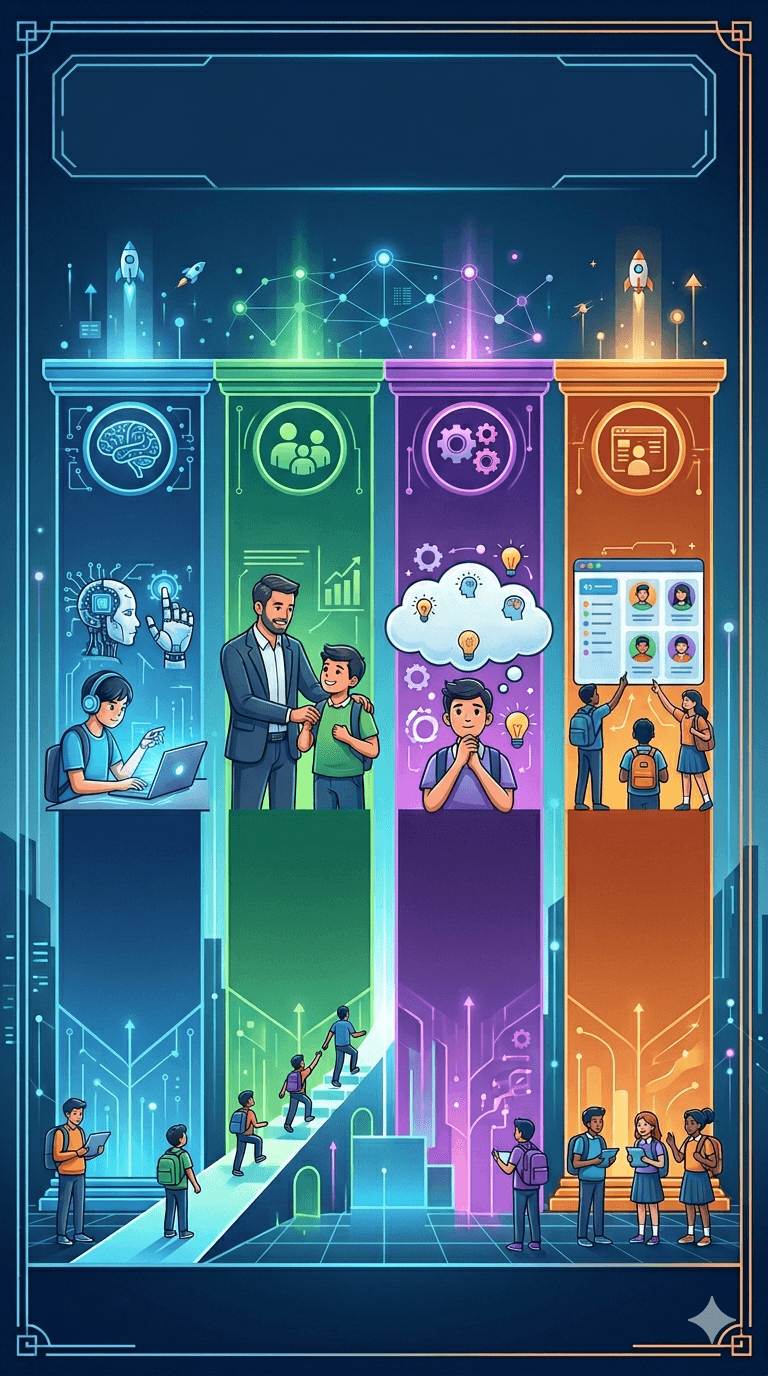
The Four Pillars of Future Education: AI, Mentorship, Skills, and Personalization
Education Is Evolving
The world our children are preparing for is changing faster than ever. Artificial Intelligence, automation, remote work, and global collaboration are reshaping industries and creating careers that did not exist a decade ago.
Yet many educational systems still rely on a one-size-fits-all approach, where every student follows the same curriculum, learns at the same pace, and is measured by the same standards.
The future demands something different.
Future-ready education is built on four powerful pillars: Artificial Intelligence, Mentorship, Skills Development, and Personalization. Together, these pillars create a learning environment that prepares students not only for exams but for life.
Pillar 1: Artificial Intelligence – The Personal Learning Companion
Artificial Intelligence is transforming education from standardized instruction to personalized learning.
AI-powered learning platforms can identify a student's strengths, weaknesses, learning pace, and interests. Instead of forcing students to adapt to the system, AI helps the system adapt to the student.
Imagine having a tutor available 24/7 that can explain concepts in multiple ways, provide instant feedback, and create customized learning paths based on individual progress.
AI does not replace teachers; it enhances learning by making education more accessible, efficient, and personalized.
Benefits of AI in Education:
Personalized learning pathways
Instant feedback and assessment
Adaptive learning experiences
Continuous progress tracking
Improved student engagement
Pillar 2: Mentorship – Guiding Beyond Academics
Knowledge alone is no longer enough.
Students need guidance, motivation, emotional support, and real-world perspectives to navigate an increasingly complex world.
Mentors help learners develop confidence, resilience, leadership, and decision-making abilities. They provide direction, encourage self-discovery, and help students connect education to real-life goals.
A strong mentor can inspire a student to dream bigger, overcome challenges, and unlock hidden potential.
In future education, mentorship becomes just as important as academic achievement.
Pillar 3: Skills Development – Preparing for the Real World
Employers today are looking beyond grades.
They seek individuals who can think critically, communicate effectively, solve problems creatively, and adapt to change.
Future education must focus on practical, transferable skills such as:
Critical Thinking
Creativity
Communication
Collaboration
Leadership
Entrepreneurship
Digital Literacy
AI Literacy
Financial Awareness
These skills empower students to succeed regardless of how industries evolve.
The goal is not simply to prepare students for the next exam but to prepare them for lifelong success.
Pillar 4: Personalization – Every Child Learns Differently
Every child is unique.
Some students learn visually, others through hands-on experiences. Some excel in mathematics, while others thrive in arts, sports, technology, or entrepreneurship.
Traditional systems often expect students to fit into predefined structures. Personalized education takes the opposite approach by designing learning experiences around the learner.
When education is personalized:
Students learn at their own pace
Learning becomes more meaningful
Confidence improves
Curiosity increases
Outcomes become stronger
Personalization allows students to focus on their strengths while receiving support where they need it most.
Bringing the Four Pillars Together
The future of education is not about choosing between technology and human connection. It is about combining the best of both worlds.
Imagine a learning ecosystem where:
AI provides personalized learning support.
Mentors guide personal growth and goal setting.
Skills-based learning prepares students for the future.
Personalized pathways help every child thrive.
This is education designed around the learner rather than the system.
Conclusion
The future belongs to learners who can adapt, innovate, and continuously grow.
By embracing AI, Mentorship, Skills Development, and Personalization, we can create educational experiences that empower every child to reach their full potential.
The question is no longer whether education will change.
The question is whether we are ready to build learning environments that truly prepare students for the future.
Because the future of education is not standardized.
It is intelligent, human-centered, skill-focused, and deeply personal.